

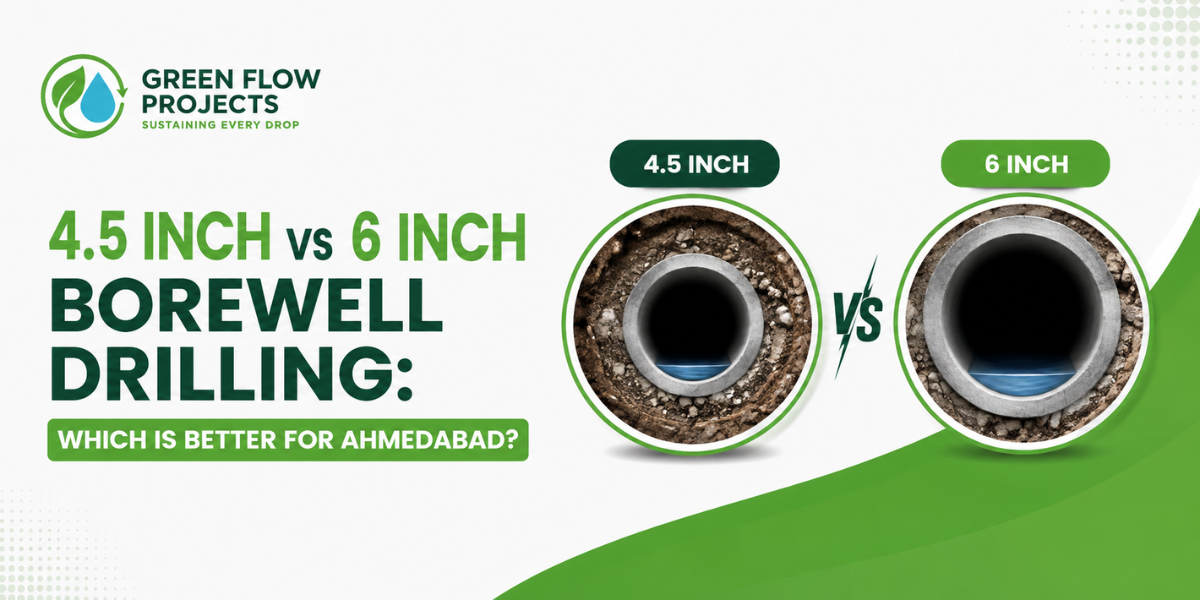
4.5 Inch or 6 Inch Borewell, Which Should You Choose?
A 4.5-inch borewell suits most residential properties, since it fits standard household submersible pumps and costs less to drill. A 6-inch borewell is generally the better choice for commercial, industrial, or agricultural use, where higher-capacity pumps and greater water demand require the extra clearance.
The right diameter isn’t just about pump size, it also affects drilling cost, casing strength, and how easily the borewell can be serviced later.
This comparison breaks down exactly where each size makes sense, and what to consider before deciding.
1. What Do 4.5 Inch and 6 Inch Actually Mean?
These numbers refer to the internal diameter of the casing pipe lining the borehole, roughly 114 mm for a 4.5-inch casing and 150 mm for a 6-inch casing. The drilled hole itself is slightly wider than the casing to allow room for the pipe and any gravel pack around it.
This diameter determines what size pump can physically fit inside, and how much water can move through the borewell at once.
2. Pump Compatibility
Pump size has to match casing diameter with enough clearance for water flow and heat dissipation around the motor. A 4.5-inch casing generally accepts pumps up to around 4-inch outer diameter, suitable for most domestic submersible pumps up to a few horsepower.
A 6-inch casing accommodates larger pumps with higher horsepower ratings, which is often necessary for commercial buildings, farms, or any application needing sustained high-volume output.
3. Water Yield and Capacity
Yield depends primarily on the aquifer itself, not the casing diameter, a wider borewell doesn’t automatically mean more water. What it does allow is a larger pump that can extract water faster from a good aquifer, and handle higher continuous demand without straining the motor.
For a residential property with modest daily usage, a 4.5-inch borewell paired with an appropriately sized pump is usually sufficient, provided the aquifer itself has adequate yield.
4. Drilling Cost Differences
Wider boreholes cost more to drill, since more material has to be removed and more casing pipe is needed to line the hole. A 6-inch borewell typically costs noticeably more per foot than a 4.5-inch one, on top of a larger, more expensive pump.
This makes 4.5-inch the more economical choice whenever the intended use doesn’t genuinely require the extra capacity.
5. Casing Strength and Durability
Casing pipe construction practices in India have historically followed Bureau of Indian Standards codes of practice for tubewells and borewells, which set out specifications for pipe strength, jointing, and installation depth ratings.
Regardless of diameter, casing should be rated for the actual depth and pressure conditions at your site, a wider pipe isn’t automatically stronger if it’s the wrong grade for the depth involved.
6. Which Is Better for Residential Use?
For most homes and housing societies, a 4.5-inch borewell is the practical choice. It’s cheaper to drill, fits standard domestic pumps, and covers typical daily water needs for a household.
A 6-inch borewell only makes sense residentially if the property has unusually high water demand, a large housing society, a property with extensive landscaping, or a building expecting future expansion. Most borewell contractors in Ahmedabad will recommend 4.5-inch as the default for single-family homes.
7. Which Is Better for Commercial or Agricultural Use?
Commercial buildings, factories, and farms typically need higher-capacity pumps to meet demand, which makes 6-inch the more sensible choice. It also leaves room to upgrade to a larger pump later without redrilling, which is a real advantage for growing operations.
Agricultural borewells, in particular, often need the higher flow rates that only a wider casing and larger pump combination can reliably deliver.
8. Ahmedabad-Specific Considerations
Groundwater conditions add another factor to this decision. Nationally, the Ministry of Jal Shakti’sDynamic Ground Water Resource Assessment Report for 2023 recorded 736 out of 6,553 assessment units across India as over-exploited, meaning extraction exceeds natural recharge in those areas.
In regions facing this kind of groundwater stress, reaching a reliable aquifer often means drilling deeper or accessing a lower aquifer layer. A wider borehole gives more flexibility for equipment and future servicing at greater depths, which is worth discussing with your contractor based on your specific locality.
Side-by-Side Comparison
| Factor | 4.5 Inch | 6 Inch |
| Typical use | Residential | Commercial, agricultural, industrial |
| Pump size fit | Standard domestic pumps | Higher HP pumps |
| Drilling cost | Lower | Higher |
| Future pump upgrade room | Limited | More flexible |
| Best for | Everyday household needs | High-volume, sustained demand |
A proper site survey from experienced borewell drilling services in Ahmedabad is the most reliable way to confirm which diameter actually fits your property’s water needs and local aquifer conditions.
Frequently Asked Questions
Can I upgrade a 4.5-inch borewell to fit a bigger pump later?
Not easily. The casing diameter is fixed once installed, so if you expect future demand to grow significantly, it’s worth discussing 6-inch upfront rather than redrilling later.
Does a 6-inch borewell guarantee more water?
No. Yield depends on the aquifer, not the casing width. A wider borewell simply allows a larger pump to extract available water faster.
Is 4.5-inch casing strong enough for deep drilling?
Yes, provided the pipe grade is rated for the specific depth and pressure conditions at your site. Diameter and depth rating are separate specifications.
Which size is more common for homes in Ahmedabad?
4.5-inch is the more common default for residential properties, with 6-inch reserved for higher-demand situations.
Does casing diameter affect water quality?
Not directly. Water quality depends more on casing integrity, aquifer depth, and surrounding contamination sources than on the diameter itself.
How do I know which size my property actually needs?
A site survey combined with an honest estimate of your daily water demand gives the most accurate answer, rather than defaulting to one size for every property.
Key Takeaways
● 4.5-inch borewells suit most residential properties and cost less to drill
● 6-inch borewells suit commercial, industrial, and agricultural use with higher pump demands
● Casing diameter affects pump size and future upgrade flexibility, not the aquifer’s actual yield
● Wider boreholes cost more per foot, so choose based on real water demand, not assumption
● A proper site survey is the most reliable way to confirm the right diameter for your property
Conclusion
Choosing between 4.5-inch and 6-inch comes down to matching the borewell to your actual water needs, not simply picking the bigger option. Most homes are well served by 4.5-inch, while commercial and agricultural properties usually benefit from the extra capacity of 6-inch.
If you’re unsure which fits your property, Green Flow Projects can assess your site and recommend the right diameter based on your actual usage and local groundwater conditions.