
What Determines Borewell Drilling Cost in Ahmedabad?
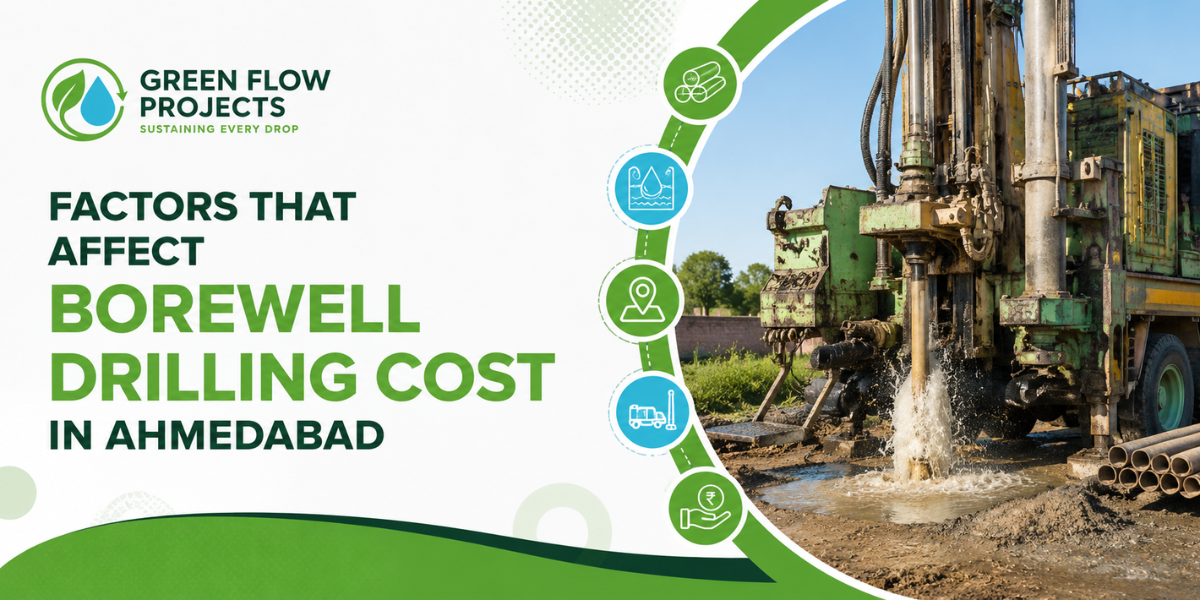
Borewell drilling cost in Ahmedabad is driven mainly by depth, rock hardness, casing pipe specification, borehole diameter, site accessibility, and whether permits or groundwater compliance work is needed. No two sites cost exactly the same, because each of these factors changes independently.
Understanding what actually moves the price helps you read a quote properly, instead of just comparing bottom-line numbers between contractors.
This guide walks through each cost factor individually, so you know what you’re paying for and why.
1. Depth and Groundwater Level
Depth is usually the single biggest cost driver, since drilling is billed by how far down the rig has to go. Deeper drilling means more time, more casing pipe, and more wear on the drilling equipment.
Ahmedabad’s groundwater situation makes this especially relevant. According to the Dynamic Ground Water Resources of India 2023 report, published by the Central Ground Water Board under the Ministry of Jal Shakti, groundwater extraction levels have been rising nationally, which generally corresponds to deeper drilling being needed to reach reliable water in stressed regions.
A site survey gives the most accurate depth estimate before drilling starts, rather than relying on a citywide average.
2. Rock Type and Geology
Ahmedabad’s subsurface isn’t uniform. Some areas have soft alluvial soil close to the surface, while others hit hard rock formations at moderate depth.
Hard rock, granite or basalt, takes longer to penetrate and wears down drilling bits faster than soft soil. That extra time and equipment cost is reflected directly in the per-foot drilling rate. A contractor who quotes without knowing the rock type at your specific site is guessing.
3. Casing Pipe Material and Standard
Casing pipe protects the borehole from collapsing and keeps surface contaminants out of the water. It’s priced by material, diameter, and length, and it should meet recognized construction standards, not just be the cheapest option available.
In India, casing and screen pipes used in borewell construction fall under Bureau of Indian Standards codes, specifically IS 2800-1, the Code of Practice for Construction and Maintenance of Wells in Alluvium, and the related IS 12818 specification for uPVC casing pipes. Pipe rated for greater depth generally costs more, since it needs to withstand higher external pressure.
Shallow-well-rated casing used at depths it isn’t designed for is a common way contractors cut corners, and it shows up as a lower quote upfront.
4. Borehole Diameter
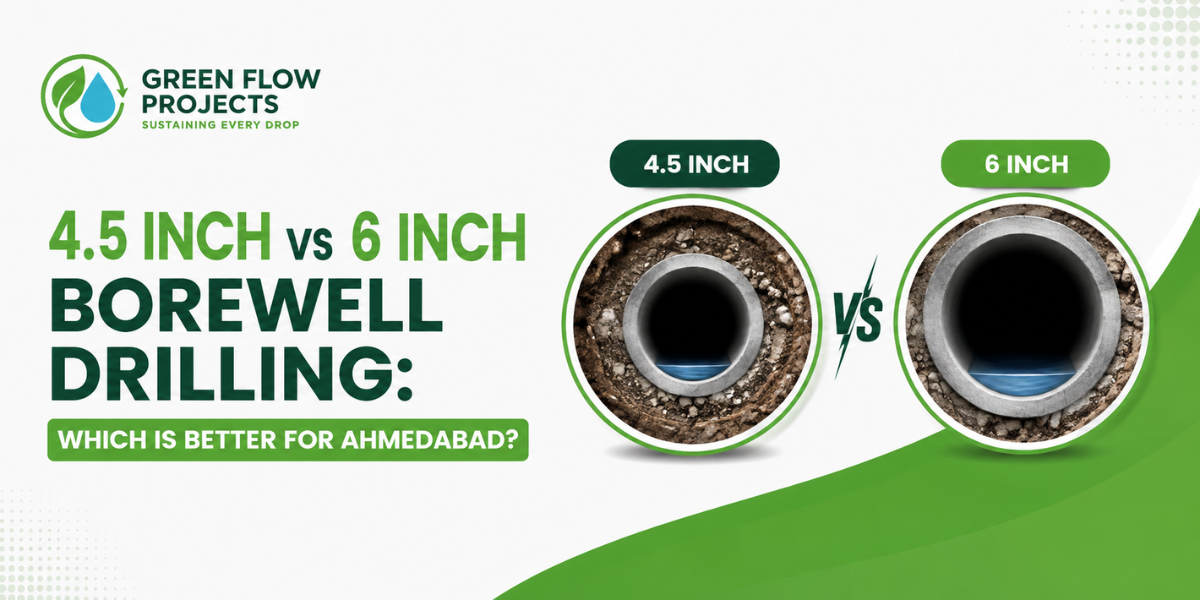
Wider boreholes cost more per foot than narrower ones, since more material has to be removed and more casing is needed to line the hole. Residential borewells typically use a narrower diameter than commercial or agricultural ones, which often need a wider bore to support a larger pump.
5. Permits and Groundwater Compliance
Gujarat regulates groundwater extraction through the Gujarat Water Resources Development Corporation, a state government body responsible for groundwater development and management. Commercial and industrial borewells typically require approval before drilling, and this compliance work adds a documentation cost on top of the physical drilling.
Sites in notified or water-stressed zones may face additional scrutiny, which can extend both cost and timeline. A contractor should tell you upfront whether your specific site falls into this category.
6. Pump and Motor Specifications
The submersible pump and motor are priced separately from drilling, based on horsepower rating and brand. A higher-yield borewell generally needs a larger pump to make full use of the available water, which raises the total project cost even if drilling itself was straightforward.
Buying a pump before yield testing is a common mistake, it’s better to size the pump to the borewell’s actual measured output.
7. Site Accessibility
Tight urban plots, restricted vehicle access, or the need to position heavy rigs in confined spaces can add time and labor cost. A site that’s easy for a rig to reach and set up on generally costs less than one requiring extra positioning work.
8. Yield Testing and Development Work
After drilling, the borewell needs to be developed, cleared of drilling debris, and tested to measure actual water discharge. This step is sometimes bundled into the drilling quote and sometimes billed separately, so it’s worth confirming which applies before comparing prices between contractors.
9. Contractor Experience and Equipment
Two borewell contractors in Ahmedabad quoting for the same site can land on different numbers simply because of the rig technology used. Modern DTH (Down-The-Hole) hammer rigs drill hard rock faster and straighter than older rotary equipment, which can offset a slightly higher rate with less total drilling time.
Experience also affects cost indirectly, a contractor who surveys properly and drills the right depth the first time avoids the far larger cost of redrilling later.
How to Read a Borewell Quote
A complete quote should separate out each cost driver rather than bundling everything into one number:
| Line Item | What to Check |
| Drilling charge | Rate per foot, and whether it changes with depth or rock type |
| Casing pipe | Material, diameter, and depth rating |
| Pump and motor | HP rating, brand, and whether it’s sized after yield testing |
| Yield testing | Whether it’s included or billed separately |
| Permit assistance | Whether documentation support is included |
If you’re comparing quotes for borewell drilling services in Ahmedabad, ask each contractor to break down pricing this way. It’s the only way to compare like with like.
Frequently Asked Questions
Why does borewell drilling cost vary so much between sites in the same city?
Depth to water and rock hardness both vary by locality, even within the same city, so two nearby sites can have very different drilling requirements.
Does deeper drilling always mean higher quality water?
Not automatically, but reaching a lower aquifer layer instead of stopping at the first water strike often means cleaner, more stable water, which is part of why depth affects both cost and outcome.
Is casing pipe standard the same everywhere in India?
Casing pipes used in borewell construction are expected to meet Bureau of Indian Standards specifications, though the specific grade needed depends on depth and pressure conditions at your site.
Do all borewells in Gujarat need a permit?
Not all, but commercial, industrial, and large-scale domestic borewells generally require registration or approval through the state groundwater authority. A contractor should confirm this for your exact site.
Should I choose the lowest quote I receive?
Not without checking what it excludes. A lower quote that skips proper casing standards, yield testing, or permit support often costs more later in repairs or redrilling.
How can I get an accurate cost estimate for my property?
A proper site survey is the only reliable way, since depth, rock type, and access all vary by exact location, not just by city or neighborhood.
Key Takeaways
● Depth and rock hardness are usually the biggest drivers of borewell drilling cost
● Casing pipe should meet recognized construction standards, not just be the cheapest option
● Permits and groundwater compliance can add cost, especially for commercial or industrial sites
● A complete quote should separate drilling, casing, pump, testing, and permit costs individually
● A proper site survey gives a far more accurate cost estimate than a generic citywide average
Conclusion
Borewell drilling cost in Ahmedabad isn’t one fixed number, it moves with depth, rock type, casing quality, and site conditions specific to your property. Understanding these factors makes it much easier to compare quotes fairly and avoid surprises later. If you’d like a site-specific estimate rather than a generic figure, Green Flow Projects can walk you through what your particular site actually needs before you commit to a contractor.