
A borewell is one of the most valuable assets on your property, whether you use it for daily household needs, irrigation, or commercial purposes. But like any infrastructure that works silently underground, it only gets attention when something goes wrong.
By then, the damage is done.
What most borewell owners in Ahmedabad and Gandhinagar don’t realise is that 80% of borewell failures — reduced water output, pump breakdowns, and water contamination are preventable with timely maintenance. A little attention twice a year can add years to your borewell’s life and save tens of thousands in emergency repair costs.
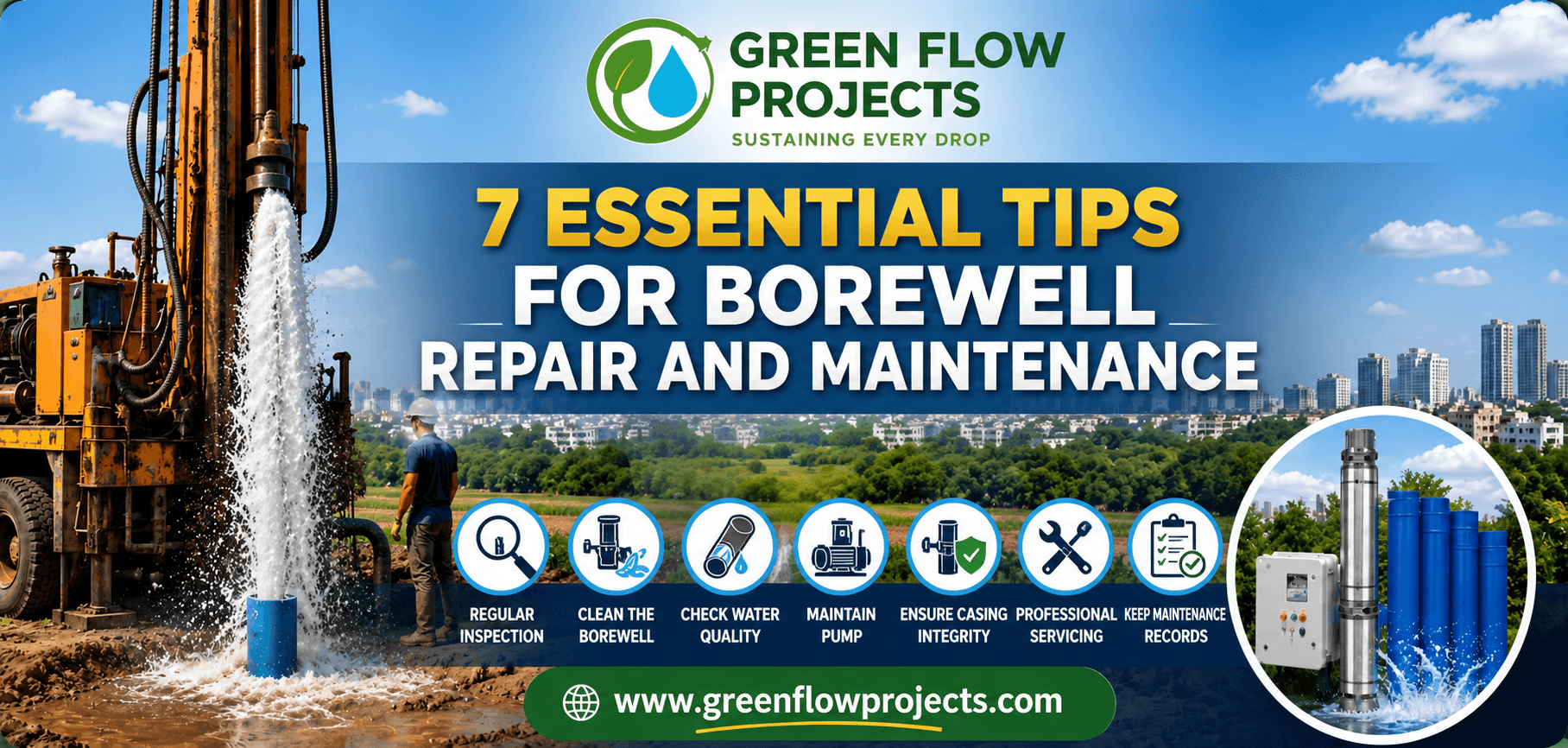
This guide covers 7 practical, field-tested maintenance tips that every borewell owner should follow — along with clear signs that your borewell needs immediate professional attention.
Why Borewell Maintenance Is Often Ignored (And Why That’s a Costly Mistake)
Out of sight, out of mind that’s how most people treat their borewells. Once drilling is done and water is flowing, the borewell is forgotten until there’s a crisis.
The problem? Groundwater conditions change. Soil shifts. Pump components wear out. Bacterial growth happens in stagnant water zones. And the longer these issues go unaddressed, the more expensive the repair.
Regular borewell maintenance protects your water supply, extends the pump and casing lifespan, keeps your water quality safe, and prevents full borewell failure — which sometimes means re-drilling entirely.
Here’s what you need to do.
Tip 1: Schedule a Borewell Inspection at Least Once Every Two Years
The single most effective thing you can do for your borewell is get it professionally inspected every 24 months — or sooner if you notice any performance changes.
A proper inspection covers:
- Water level measurement — checking if the static water level has dropped compared to previous readings
- Pump performance check — measuring discharge rate against the original pump specs
- Casing condition — looking for cracks, corrosion, or joint failures
- Electrical check — testing motor amperage, voltage, insulation resistance, and wiring condition
- Water quality sampling — testing for pH, turbidity, TDS, bacterial contamination
Many borewell owners skip this because the water appears fine. But gradual changes in water quality or yield often signal deeper problems that worsen over time. Catching them early costs far less than dealing with a failed borewell.
In Ahmedabad and Gandhinagar, where groundwater levels have been under significant stress in some zones, annual checks are advisable — especially in older borewells or those with heavy daily usage.
Tip 2: Never Ignore Reduced Water Output — Investigate Immediately
If your borewell is delivering less water than usual, most people assume the water table has dropped and do nothing. Sometimes that’s true. But reduced yield can also indicate:
- Sand or silt accumulation at the bottom of the borewell, blocking water inflow
- Clogged screen or slotted casing that restricts water entry into the borewell column
- Pump wear — impellers wearing out, reducing discharge capacity
- Drop in pump position or misalignment due to cable stretch or connection issues
- Actual groundwater depletion in the aquifer zone
Each cause has a different solution. Blindly replacing the pump when the real issue is a clogged screen is wasted money. A borewell camera inspection is the most reliable diagnostic tool — it gives a direct visual of what’s happening inside the borewell without any guesswork.
At Green Flow Projects, we use camera inspection as part of our maintenance assessment before recommending any repair work. It saves our clients both time and unnecessary expense.
Tip 3: Flush Your Borewell Regularly to Clear Sediment Build-Up
Borewell flushing is one of the most underused yet effective maintenance practices.
Over time, fine sand, silt, and mineral deposits settle at the bottom of the borewell and accumulate in the screen zones. This reduces the effective depth of the borewell, restricts water entry, and can damage the pump if sediment is drawn in.
Flushing — using compressed air or water jetting — dislodges and removes this material, restoring the borewell’s effective depth and yield.
How often should you flush a borewell?
- Domestic borewells in normal soil conditions: every 3–5 years
- Borewells in sandy or silty zones: every 1–2 years
- Agricultural borewells with heavy seasonal use: after every monsoon season
Signs that flushing is overdue include: sandy or gritty water at the tap, gradual drop in water output with no change in water table, and pump making unusual sounds due to sediment ingestion.
Tip 4: Test Your Borewell Water Quality Annually
Groundwater quality is not static. It can change due to:
- Nearby construction, excavation, or new borewells
- Agricultural runoff seeping into shallow aquifers
- Seasonal variation (post-monsoon water often carries more surface contamination)
- Old or cracked casing allowing surface water ingress
- Natural mineral leaching from geological formations
Regular water quality testing is essential — not just for safety but also for your pump and plumbing. Hard water with high TDS, high iron content, or acidity corrodes pump components faster and causes scaling in pipes.
Basic parameters to test annually:
| Parameter | Why It Matters |
| TDS (Total Dissolved Solids) | Indicates overall mineral load |
| pH Level | Affects corrosion and taste |
| Hardness | Impacts scaling and pump wear |
| Iron & Manganese | Causes staining, taste issues |
| Bacterial Count (E.coli) | Critical for drinking water safety |
| Nitrates | Indicates agricultural contamination |
If your borewell water is used for drinking, testing becomes non-negotiable. For irrigation use, TDS and pH are the primary parameters to watch.
Tip 5: Protect the Borewell Head — It’s Your First Line of Defence
The borewell casing at the surface level (the exposed head) is often the most neglected part of the entire setup. And it’s critically important.
A damaged, poorly sealed, or uncovered borewell head allows:
- Surface water (including rainwater runoff) to enter the borewell and contaminate the groundwater
- Insects, rodents, and debris to fall into the borewell
- Soil and gravel to gradually slip into the column
- Children or animals to accidentally access the open borewell
What a properly maintained borewell head should look like:
- A fitted, lockable cap or cover on the casing top
- The casing extending at least 30 cm above ground level
- A concrete apron or platform around the borewell to divert surface water away
- All cable and pipe entry points sealed properly
- No standing water or pooling around the borewell structure
Check the borewell head after every monsoon season — it’s when the most damage typically occurs from flooding, waterlogging, and soil erosion.
Tip 6: Maintain Your Submersible Pump Proactively — Don’t Wait for It to Fail
The submersible pump is the most mechanically complex and expensive component of your borewell system. Waiting for it to break down completely before servicing it is the most expensive approach you can take.
Submersible pump maintenance checklist:
- Check motor current draw — if the pump is drawing more current than rated, it’s overworking, usually due to wear, clogging, or voltage issues
- Inspect the drop pipe connections — corrosion or loose joints can cause the pump to drop, making retrieval difficult and expensive
- Test insulation resistance (megger test) — low insulation reading warns of impending motor failure before it happens
- Lubricate and check the starter panel — contactors, overload relays, and capacitors in the control panel degrade over time
- Inspect the foot valve — a faulty foot valve causes the pump to lose prime and run dry, burning out the motor
A pump that runs dry — even briefly — can suffer irreversible motor damage. Many homes in Ahmedabad face voltage fluctuation issues that contribute to premature pump failure. Installing a voltage stabiliser or dry-run protection relay is a low-cost safeguard worth every rupee.
Service the pump every 2–3 years even if it’s running without visible problems.
Tip 7: Keep a Maintenance Log for Your Borewell
This tip sounds simple but is consistently overlooked. Keeping a written record of your borewell’s history is genuinely useful — both for your own reference and when a contractor comes to service or repair it.
What your maintenance log should include:
- Date of original drilling and borewell depth
- Type and depth of casing installed
- Pump make, model, HP rating, and installation depth
- Static water level at time of installation
- All inspections, dates, and findings
- Water quality test results with dates
- Any repairs done — what was done, by whom, when
- Changes in water yield or quality over time
This history helps a contractor diagnose problems faster, spot trends in water level decline, and make better recommendations. Without it, every service call starts from scratch.
You can maintain this as a simple notebook kept near your pump control panel or a basic digital note on your phone. Green Flow Projects provides a service record card to all our customers after each visit.
Warning Signs Your Borewell Needs Immediate Attention
Don’t wait for a scheduled inspection if you notice any of these:
- Sudden drop in water pressure or flow from taps fed by the borewell
- Sandy, gritty, or muddy water — indicates sediment ingress or casing damage
- Discoloured water (yellow, brown, or reddish) — may signal iron contamination, casing corrosion, or nearby surface water intrusion
- Foul smell or unusual taste — a serious red flag for bacterial or chemical contamination
- Pump running continuously without adequate water delivery — possible airlocking, dry running, or severe yield drop
- Electrical tripping when the pump starts — motor winding fault or overload condition
- Unusual vibration or noise from the pump — worn bearings, bent shaft, or debris in the pump
Any one of these warrants an immediate professional inspection — not just a quick check by an electrician.
Borewell Repair and Maintenance Services by Green Flow Projects
At Green Flow Projects, we provide complete borewell repair and maintenance services across Ahmedabad and Gandhinagar, covering:
- Borewell camera inspection & video analysis
- Borewell flushing & cleaning (air and jetting)
- Submersible pump removal, service & reinstallation
- Pump motor rewinding & repair
- Borewell casing repair and extension
- Water quality testing & report
- Electrical panel inspection and repair
- New pump & motor supply and installation
- Emergency borewell repair services
We believe in giving our clients an honest assessment not replacing parts that don’t need replacing and not missing issues that do.
Frequently Asked Questions (FAQs)
Q1. How often should a borewell be serviced?
A borewell should be professionally inspected at least once every two years under normal usage conditions. Borewells used heavily — for agriculture, commercial buildings, or apartments — benefit from annual service checks. The submersible pump should be serviced every 2–3 years regardless of visible performance.
Q2. What causes a borewell to suddenly stop giving water?
Sudden water stoppage can result from several causes: pump motor failure, dry-running damage, a broken or disconnected drop pipe, complete aquifer depletion at the current depth, or a major casing collapse. A borewell camera inspection is the fastest way to diagnose the specific cause.
Q3. How do I know if my borewell water is safe to drink?
Visual clarity and taste are not reliable indicators of water safety. Bacterial contamination, nitrates, and dissolved heavy metals are odourless and colourless. The only reliable way is annual laboratory water quality testing. For drinking water borewells, test at minimum for bacteria (E.coli), pH, TDS, nitrates, and iron.
Q4. What is borewell flushing and when is it needed?
Borewell flushing is a process that uses compressed air or high-pressure water jetting to break loose and remove accumulated sediment (sand, silt, mineral deposits) from the bottom and screen sections of the borewell. It is needed when water output drops, water appears sandy, or during routine maintenance every 3–5 years.
Q5. Can a borewell be repaired if the casing is damaged?
Yes, in many cases. Minor casing cracks or joint failures can be addressed with liner insertion or grouting. Severely collapsed sections may need a new liner borewell drilled adjacent to the damaged one. A camera inspection determines the exact nature and extent of the damage before any repair decision is made.
Q6. What is a borewell camera inspection and how much does it cost?
A borewell camera inspection involves lowering a waterproof CCTV camera into the borewell to visually inspect the casing condition, identify sediment build-up, check the pump and screen, and measure the water column. In Ahmedabad and Gandhinagar, borewell camera inspection typically costs between ₹2,500 to ₹5,000 depending on borewell depth.
Q7. Why does my borewell water smell bad after the monsoon?
Post-monsoon borewell water can temporarily carry higher levels of bacteria and organic matter due to surface runoff infiltrating shallow borewells. A damaged or inadequately sealed borewell head is the most common culprit. Shock chlorination followed by flushing, combined with fixing the borewell head seal, typically resolves this. If the problem persists, a full water quality test is recommended.
Q8. How long does a borewell last with proper maintenance?
A well-constructed and regularly maintained borewell can last 20–30 years or longer. The submersible pump typically needs replacement every 7–12 years depending on usage, water quality, and whether it’s been properly maintained. The borewell structure itself, when properly cased, has a much longer lifespan than the electromechanical components.
Q9. Is it possible to increase borewell yield without re-drilling?
In some cases, yes. Hydrofracturing (injecting high-pressure water into the borewell to widen fractures in rock formations) can improve yield in hard rock borewells. Acidisation is another technique used for certain rock types. Flushing and cleaning also restore lost yield in borewells where the screen has become clogged. A contractor can assess whether these methods are viable for your specific borewell.
Q10. Does Green Flow Projects offer emergency borewell repair services in Ahmedabad and Gandhinagar?
Yes. Green Flow Projects offers emergency borewell repair and pump replacement services across Ahmedabad and Gandhinagar. Contact us directly for urgent requirements, We prioritise situations where water supply has been completely disrupted.